-
 A transformative online experience that includes a one-hour meditation with a global community. In this free live webinar, you'll discover ways to support others with nervous system regulation during these uncertain times, how to maximize immune system functioning through regulation, how to work with children through their fears and anxieties, and how to integrate the fears to enhance health and resilience.
 -
 In this free one-hour webinar, you’ll understand how to manage your stress, fear, anxiety and depression and why it’s important to do so … And that’s not even the best part - You’ll be shown mindfulness strategy after mindfulness strategy, offered understanding of the neuroscience behind each, and guided through how to use them - go from “not just a good idea” to why you would do it and when you would use it.
 -
 Oh yes! You likely know what we're talking about ... the feeling of never being "good enough" ... holding yourself back because of pervasive feelings of shame and self-doubt ... the constant worry/anxiety of not measuring up or fear of being outed as a fraud. It may trap you in a cycle of self-doubt, erode your courage and confidence, undermine your success, and lead to missed opportunities, unfulfilled goals, and a tendency to hide or hold yourself back. Sound familiar?... [Sigh ] ... Let's take a deep breath and acknowledge how challenging and debilitating "imposter syndrome" can be. Lisa wants to help you begin to overcome imposter syndrome in your life.
 -
 In response to COVID-19, the Synergetic Play Therapy Institute began offering free webinars to address the challenges, stress and impact that therapists, teachers, parents, and those on the frontlines were facing. Since then, we've continued to offer free webinars to support you on your professional and personal life's journey. Please enjoy free access to these very special webinars. You may view and share it with as many people as you feel it would help.
 -
 Being a therapist is not an easy job as it requires an on-going commitment to show up day in and day out when your clients need you ... But what happens when the people we are serving aren't the only ones in crisis? What happens when we are in crisis too? (We are human after all). And what happens if it's the same crisis?! In this special one-hour webinar (Part 3 of Regulating Through the Coronavirus webinar series), you'll reconnect to yourself and gain greater internal resources to help you overcome many of the challenges of being a therapist right now.
 -
 Lisa Dion and her dear friend, Peter Bliss join forces again to support you in staying connected during the Holidays ....with the message that staying calm is not the objective or solution for getting through not only the challenges and uncertainty of the world we live in right now, but also this holiday season (because as we know, it's not always about cheer and jubilee).
 -
 Chances are, you read the title of the webinar and thought, "What! You want me to do what with rejection?!" (We know ... it might not quite make sense yet.) Or perhaps you know that rejection has a purpose in your life, but you still find yourself having a "love/hate" relationship with it. Either way, rejection can be one of the toughest things to experience - it gets right down to your core self and brings up all of your "Am I ok?" feelings. And this is what we're going to talk about in this one-hour free webinar! ... and more specifically, how to embrace it! - like you're best-est of friends (Yes, you heard that right too.)
 -
 Have you found it difficult, confusing, tiring, or maybe even exhausting wearing your two hats day in and day out? One as a therapist and the other as a parent?... Lisa totally gets it!!...as both a therapist and a parent these past 15 years. This one-hour recorded webinar that will help you discover ways to be the most important toy in both the playroom and in your own home!
 -
 Therapists and clinicians are always experiencing a secondary impact when working with clients who have experienced or are experiencing trauma, crisis, or challenge. A big statement, we know, but it's true. We can't avoid being impacted and it has a lot to do with the brain's mirror neuron system. When we're in the midst of listening or playing through the trauma with the child, we're tracking our client's non-verbal cues. And as we're tracking our client's non-verbal cues, their non-verbal cues are giving us insight into what is happening within them. THIS puts us directly IN the experience with our clients. We'll experience the fear together, the anxiety together, the sadness together, the overwhelm together - Whatever is going on, we'll experience it together including the trauma. That's why we would love to have you join us for this FREE 1-hour webinar to help you navigate the secondary traumatization that can often come along with this profession that we love!
 -

Choose 4 One-Hour Courses & Save!
More learning. More flexibility. More learning SPT-style. 💛 Looking to deepen your skills in a specific area of your play therapy practice—or simply curious to explore something new? Build your own learning experience with our 4-course bundle! Choose any four 1-hour online home study courses from our collection and get them all for just $119—a savings of $21 off the regular $140 value. With courses exploring everything from nervous system regulation and attachment to resistance, neurodivergence, digital play, trauma, caregivers, and so much more, you can choose the topics that speak directly to the children and families you’re supporting right now. How it works:- Browse the available 1-hour courses below.
- Choose any 4 courses that interest you.
- Purchase your bundle for just $119.
- Want to keep learning? You can purchase as many bundles as you’d like, with each bundle purchased as a separate order.
-
 In this workshop, participants will delve into the world of "shoulds" and negative self-talk; those internalized expectations and societal norms that often shape our thoughts, behaviors, and decisions while influencing our lives, physiology, and well-being. During this hour, we will uncover the complex interplay of factors that contribute to the formation of "shoulds" and most importantly, the unique role they play in our psychology. Understanding how “shoulds” and negative self-talk form, the connection they have with our physiology, and the purpose behind them will help you reframe these patterns as valuable feedback systems on the pathway toward authenticity and congruency. Don’t miss this opportunity to learn how to harness the power of “shoulds” and negative self-talk for personal growth and self-discovery! And, one of the best parts is that you will be able to take this information and have a better understanding of what is happening with your clients and loved ones, as well!
 -
 Play therapists often believe that they are lost in understanding the play and perspective of children in the play therapy process. This limitation leads to doubts about how to respond to children and how to conceptualize what is happening in play therapy. Through discovering themes of children and their play, a play therapist can empathically respond to the individual nature of each child client, leading to greater understanding in the therapeutic relationship. This webinar will offer the process for identification of themes, understanding the progression of theme resolution, and ways in which the play therapist can respond more accurately within session. Therapists will walk away knowing the typical themes that emerge in play therapy and a process by which they can learn to be more empathically attuned to their clients.
 -
 With their changing brains and hormones, finding ways to integrate play with pre-teens and teens can at times just feel “Awkward”. Learn how to navigate therapy with our clients who are no longer children, but also not quite yet adults. From twelve-year-olds to seniors in high school, adolescence is a time filled with change. This can make the notion of bringing play therapy to this population a challenge. Do we play? Do we talk? Do I ask questions? What do I do?" As such, many therapists find themselves at a loss with this age group, feeling just as confused as they do! In this workshop, play therapists will delve into the mysteries of the teenage mind as we bust myths and glean insight into how to best offer therapeutic support. Using neuroscience, Developmental, Synergetic, and Systemic theories, participants will explore how to navigate this "awkward" and sometimes "overwhelming" developmental stage using an eclectic framework of non-directive and directive play therapy approaches. Understanding how to assess the teen's emotional age, an area often missed when working with this population, will also be covered as a way to understand how to incorporate play into the therapy process. The information presented is designed to open minds and hearts as participants uncover the wisdom of the changing brain and the wisdom of the teenage years. Through lecture, demonstration, and discussion, this workshop will deconstruct this mysterious stage and support play therapists in discovering how they can help mature and remodel the teenage brain, while supporting movement towards the discovery of the authentic self- the cornerstone of the development of a teenager's identity. To get a sense for the course, check out this short video below:See course details below.
 -
 This inspiring one-hour course dives into the transformative role of play therapy in supporting neurodivergent children. Gain insights into how play can help address processing differences, executive functioning challenges, and sensory sensitivities equipping you to meet these unique profiles with confidence and compassion. Guided by over 20 years of professional and personal experience, Cary Hamilton will reveal practical, neurodiversity-affirming, play-based interventions designed to foster connection, emotional regulation, and resilience. You’ll walk away with actionable strategies to enhance your clinical practice, deepening your ability to create meaningful and effective therapeutic relationships with neurodivergent children. Don’t miss this opportunity to expand your skills, enrich your practice, and make a lasting impact on the lives of neurodivergent children and their families!
 -
 This webinar will explore the myriad ways in which children show us the hard things that have happened to them. There are as many ways for children to share their pain with us as there are stories to be told. After three decades of Storykeeping, TraumaPlay has identified three primary posttraumatic play pathways that children use to create coherence in their internal narratives. These three pathways allow for play-based gradual exposure to occur while integrating thoughts, feelings, and sensory impressions connected to the trauma. TraumaPlay gives permission for a “yes, and” approach to the sometimes overwhelming question of whether to use directive or non-directive play therapy approaches with traumatized children and expands our conceptual framework for following the child’s need in trauma processing.
 -
 Parents are a powerful force in a child’s life. Inviting them into the play therapy process is essential for creating lasting change. But let’s face it—this isn’t always easy! Many clinicians, both new and seasoned, struggle with how to effectively involve parents in therapy sessions. This dynamic course with Clair Mellenthin, LCSW, RPT-S, will equip you with the skills and confidence to build strong alliances with parents while integrating them into play therapy. Using the Attachment-Centered Play Therapy model, you’ll explore the hows, whys, whens, and what-to-dos of parent-child play therapy. You’ll also uncover practical interventions to foster attachment and connection while reflecting on the roadblocks that might arise in your own practice. It’s all designed to help you deepen your understanding of parent-child dynamics, empowering you to create meaningful change for families. Get ready to play, reflect, and transform your approach to parent involvement in therapy!
 -
 The Synergetic Play Therapy Institute in collaboration with PIP Solutions presents “Conceptualizing Cases from a Synergetic Play Therapy Lens”. Translating a right brain play experience into a left brain conceptualization is not an easy task. Play therapists often grapple with a sense of uncertainty when trying to comprehend a child’s unique therapeutic progression and assessing whether goals are being achieved. This course, led by Lisa Dion, aims to address this issue by introducing a structured framework derived from Synergetic Play Therapy. Students will gain insights into how to conceptualize cases effectively and apply this framework to enhance the efficacy of their therapeutic interventions.
 -
 Embark on an enlightening journey with Lisa Dion as she delves into strategies for optimizing the intake process! In this course, you will gain insights into how the foundation of a therapeutic relationship is laid during the intake session and how this extends throughout the entire intake and into the clinical engagement. Lisa will impart valuable lessons on structuring the intake, commencing from the initial point of contact all the way to the conclusion of the session. Witness how Lisa skillfully incorporates key themes from Synergetic Play Therapy®, such as the regulation of the nervous system and a nuanced understanding of how the brain functions, into the intake process. We will also explore the pivotal and validating role of the therapist in the playroom, emphasizing how their presence can significantly influence the dynamics of the therapeutic relationship with the client, family, and beyond.
 -
 Helping children learn how to regulate is essential, but without first strengthening the child's interoceptive sense, regulation may not be successful. This experiential workshop offers various opportunities to explore how play can develop this fundamental part of the sensory system. As play therapists, there is an understanding that regulation and co-regulation are essential skills that must be developed in order to have successful relationships and manage emotions, and are essential for trauma integration; however, what many play therapists may not fully understand is that there is a prerequisite that needs to be in place for regulation skills to be effective. What has been understood for years in the world of Occupational Therapy is now becoming a primary focus of education for play therapists. This important understanding is that the child’s interoceptive sense, the 8th sensory system that is responsible for letting the brain know how the body is doing, must be developed first before a child can successfully regulate and co-regulate. Without the development and strengthening of the interoceptive sense, a child may have all kinds of regulation knowledge and tools but will not be able to read their own body cues to know when to use any of them. Examples such as knowing when to use the bathroom, when to take a deep breath, when to ask for help, the ability to read non-verbal cues, knowing when emotions are feeling overwhelming, etc. all rely on interoception. This playful workshop is designed to help play therapists learn what the interoceptive sense is and how to use play to develop interoception in their child clients setting the stage for successful regulation and co-regulation. Play therapists will have fun experientially exploring this fundamental part of the sensory system! (This course is a recording of a 2 hour live webinar held in November 2023) See course details below.
 -
 From a stroll through the Lollipop woods of Candyland to a fight over the Thimble in Monopoly, games are part of childhood. In the playroom, certain games are more commonly used than others. How do we use chess as a pawn in our therapeutic healing? How can we call on checkers to check on the child’s state of regulation? What does a game tell us about a child’s emotional world? This webinar explores these questions and more!
 -
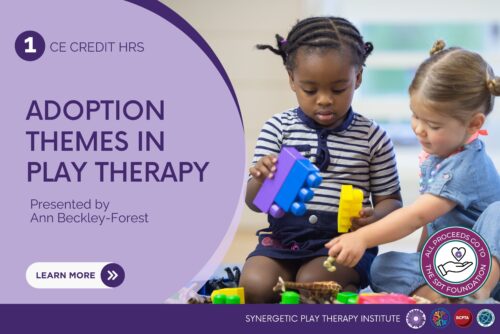 While adoption is often seen as the solution to the problem of child maltreatment, the disruption of primary attachments is also a risk factor for children after placement. Play therapists can play an important role in recognizing the impact of these attachment wounds as well as themes of belonging and identity formation that become increasingly pressing for children as they grow up in adoptive families, foster families, and kinship adoption. In this session we will look at a prescriptive play therapy approach to this work including the themes that can emerge in the child’s play, approaching the traumatic history of disruption and placement through the attachment narratives, and how to support the adoptive parents in adjusting their expectations and strategies. Of special note will be the important considerations related to race, ethnicity, and culture that often impact the adoption kinship network and ways to invite those themes in the play therapy process.
 -
 This workshop equips play therapists with practical, role-affirming strategies to strengthen collaboration with educators. You’ll discover how to support teachers in ways that honor their expertise and responsibilities—while still bringing your own clinical lens to the table. In compliance-heavy, high-stress environments, educators often feel unseen or overwhelmed. Together, we’ll examine how we may unintentionally be “shoulding” educators—adding to their stress—and explore how to instead foster empowerment, clarity, and authentic connection. Blending clinical insight with hands-on application, this session helps you partner with educators in ways that build trust, reduce overwhelm, and create space for growth.
 -
 Divorce. The “D” word. The end of the marital road. A happily ever after run amok. It’s something that often gets a bad rap, especially when we think of the children stuck in the middle. But divorce, while it can be devastating to some kids, can also be a relief for others. Children’s perceptions are not all the same. This course explores how to support children in play therapy when they are experiencing divorce and separation.
 -
 Research in neuroscience and interpersonal neurobiology sheds light on the need for the play therapist to act as the external regulator supporting the child to move towards the intensity they are experiencing allowing for integration. This 3 hour video course explores this need during trauma integration for two primary reasons: 1) The child need to borrow the play therapist’s regulatory capacity as they work through their traumatic thoughts, feelings and sensations in play therapy and 2) The play therapist’s ability to regulate themselves during the intensity increases the capacity for presence and attunement with the child, while simultaneously supporting the health and longevity of their own nervous system. Without the ability of the play therapist to become the external regulator for the intensity that arises during trauma integration, both the child and the play therapist are at risk for emotional flooding and high levels of dysregulation in their nervous systems. Over time, this can significantly impact a play therapist’s longevity in the field, as well as the ability to stay attuned and present to a child in sessions. This course is a recording of a 3 hour live webinar with Trusted Provider Network. See course details below.
 -
 Children who have been sexually traumatized are often in need of our clinical services. Both directive and non-directive play therapy approaches provide these traumatized children with healing and the repair of losses associated with sexual trauma, such as innocence, trust, and appropriate boundaries. In this course you will develop your expertise and become a more effective advocate for your child clients with the knowledge and insight offered through this presentation. You will learn about sexual development in children, the psychological markers of sexual trauma, and the special issues these children present in play therapy, including: consulting with non-offending parents, dealing with the powerful impact of countertransference, and setting limits. Scroll down for all of the course details!
 -
 Discover how playful, nature-themed breathwork can transform your play therapy practice in this engaging one-hour course with Jackie Flynn. Learn to gently guide clients of all ages out of “stuck” survival states, enhancing nervous system flexibility and fostering resilience through co-regulation. This course introduces practical, nature-inspired techniques that blend breathwork and movement to create a felt sense of safety, deepen therapeutic connections, and support clients in accessing emotional regulation. Through shared, playful experiences rooted in nature, you’ll discover how to bring fresh, adaptive interventions into your sessions with your clients.
 -
 Helping a child heal involves helping them be themselves. One of the best ways to foster this type of environment is to cultivate safety. The therapist knowing the playroom is safe is not enough; the child must know it, too. This course explores what a neuroception of safety is and how to create it within the child and yourself.
 -
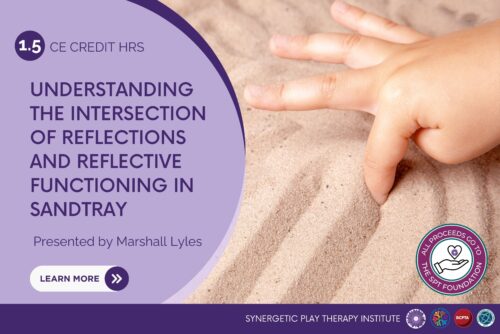 Sandtray therapy prominently features the art of reflecting. In fact, it may be the therapy skill most associated with the craft. However, we can become so accustomed to the language of reflecting that we can lose contact with its intent. In this course, you will explore the skill of reflecting through the lens of the attachment theory concept of reflective functioning. Marshall Lyles will walk you through examples honoring this intersection through use of the sand tray. Scroll down for all of the course details!
 -
 From the dad with doubts to the mom with mixed emotions, not all parents are sold on the idea of play therapy. The resistant parent is a parent who may have questions, shame, or confusion about the process. This course explores how to encourage parental understanding of the power of play and why it’s a key step in helping children heal.
 -
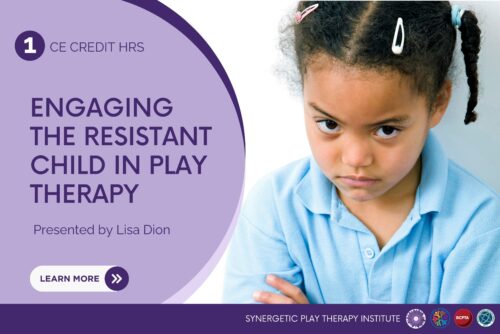 Every therapist has been there – in a session with a child who doesn’t want to come in the room, a child who doesn’t want to do the task, a child who only wants to avoid the issue. This course explores what to do when a child client’s language and behavior say “no.” Join us as we explore resistance- what it is and what it is not. This course will further explore emotional avoidance and flooding as components of resistant behaviors.
 -
 Aggression and death are common parts of the play therapy process, yet many therapists don’t have a clear understanding of what to do and how to facilitate intensity. This can lead to inadvertently promoting aggression and low brain disorganization. It can also lead to the therapist feeling beat up, exhausted, and hyper-aroused, ultimately impacting their ability to stay attuned, remain present, and find inspiration in this field. Enter Synergetic Play Therapy! Through an SPT lens, and a heavy dose of neuroscience, this 2-hour course helps therapists learn how to use play in a way that supports regulation – their own and their client’s! See course details below.
 -
 This course supports play therapists as they learn about setting boundaries from a neurobiological perspective, keeping the child’s brain and nervous system activation in mind! Drawing from Interpersonal Neurobiology and Synergetic Play Therapy, participants will learn how to set boundaries without shaming the child or stopping the child’s play, allowing for deeper integration and connection. Working with emotional flooding (the child’s and the therapist’s) will also be explored. Please scroll down for course details.
 -
 In today’s digital era, children’s play has expanded into new realms, where they engage, connect, and communicate in transformative ways. To support young clients effectively, play therapists must understand and embrace the evolving world of digital play. This insightful course with Dr. Rachel Altvater explores how the digital landscape shapes children’s engagement, self-expression, and identity. Starting with a reflection on your own perspectives about digital native culture, you’ll dive into how digital environments influence children and adolescents, equipping you to meet them where they are. Through practical strategies, you’ll learn to connect with clients in their digital spaces, foster meaningful therapeutic relationships, and seamlessly integrate digital tools into your play therapy practice. The session also examines the vital role of digital identity, uncovering how this space serves as more than entertainment—it’s where young clients form relationships, build resilience and navigate their world. By the end of this course, you’ll walk away with fresh insights and actionable techniques to strengthen the therapeutic alliance, deepen connections, and achieve meaningful outcomes with the digital natives you serve.
 -
 Sibling rivalry is a common phenomenon in family systems and thus a common reason siblings are brought to play therapy! Have you ever wondered how to support siblings in play therapy? Do you work with them individually, together or with the entire family system? Do you take a non-directive or directive approach? When they are in the room together, what exactly do you do? This webinar will answer these questions and more! You will walk away with a better understanding of how best to support siblings in play therapy, along with creative ideas as to what to do when they are in the room together!
 -
 Lisa Dion and Dr. Robert Jason Grant, creator of AutPlay Therapy, discuss what Sensory Processing Disorder is, how to begin to understand it in the context of play therapy, and offer helpful suggestions for therapists to get started.
 -
 We know that supporting a child struggling with obsessive compulsions can be incredibly challenging. Often, the desire to move the child out of their rigidity and rituals can overshadow the deeper issues and stressors driving the behaviors. We also know that Obsessive Compulsive Disorder is a complex disorder as the reasons behind the behaviors vary widely from managing anxiety to past traumas to focused energy inside of a child driving them towards their genius and that which is most meaningful. Due to the complexity, we can often mis-label, mis-understand, and mis-guide these children in how to work with and understand their rituals and need for perfectionism. We also can inadvertently intensify the inner struggle that is often experienced by these children as they attempt to stop, control, and even deny the urges in their bodies. And that is why we created this course, so you know what to do when OCD shows up in your play therapy sessions! Drawing from Synergetic Play Therapy and Interpersonal Neurobiology, this course explores non-directive and directive play based interventions to help support play therapists on a path to understand the perfection in these children's perfection, while teaching the child how to do the same. Play therapists will take a deeper look at the regulatory function of the child’s behaviors that manage the internal conflicts and anxieties these children often carry. Through discussion topics and experiential exercises, play therapists will learn how to separate the underlying drivers from the wisdom of the rituals themselves. With this knowledge, play therapists will learn how to use themselves and many forms of play to help these children access an understanding of the greatest perfection that exists, the child just as they are. “I loved Lisa's knowledge and approach - very open minded but also structured. Her personal stories of working with clients were very impactful and made it easy to attach the theories to real scenarios.” - Student testimonial See the full course description below.