Holding the Child Who Won’t Be Held: Working with Avoidant and Dismissive Attachment in the Playroom
Some children don’t cling. They don’t protest. They may appear independent, self-contained, or even unaffected. But beneath that independence can live a deep fear of rejection—and a learned belief that needing others isn’t safe.
In the playroom, avoidant and dismissive attachment patterns may show up as distance, compliance, control, emotional flatness, or a child who seems determined to need nothing from you. And when a child doesn’t reach for connection, therapists can find themselves wondering: How do I reach them without pushing them further away?
Drawing from Synergetic Play Therapy and the neurobiology of attachment, this course explores what may be happening beneath the child’s presentation and how the therapeutic relationship can become a place where something new is possible.
Rather than trying to make a child connect, you’ll explore how to use your own regulated, congruent presence to create the conditions for connection to emerge at the child’s pace. You’ll deepen your understanding of how avoidant attachment patterns can unfold in the therapeutic relationship and discover ways to stay attuned when a child’s greatest expression of vulnerability may be keeping you at a distance.
Because sometimes the most powerful invitation to connection is not reaching harder—it’s learning how to hold steady.
A 1-hour home study course exploring the neurobiological and relational foundations of avoidant and dismissive attachment and how to support these children through the therapeutic relationship and the play therapy process.
Holding the Child Who Won’t Be Held: Working with Avoidant and Dismissive Attachment in the Playroom quantity
Neuroception of Safety in the Playroom: What It Is & How to Create It
A playroom can be warm, welcoming, and carefully designed for children—and yet a child may not experience it as safe. Safety isn't simply something we provide; it's something the nervous system continually senses and interprets. For a child to truly engage in the therapeutic process, their body needs to have an experience of safety, not just their mind being told that they are safe.
In this 1-hour home study course, you'll explore the concept of neuroception of safety and its importance in the playroom through a Synergetic Play Therapy lens. You'll deepen your understanding of the nervous system and how different states influence a child's capacity to connect, play, and engage in therapy. You'll also explore the therapist's role in cultivating an environment where safety can be experienced—not only through what we say and do, but through our own regulated presence.
A key part of this work is learning how to stay connected to the child while also staying connected to yourself. You'll explore the SPT concept of being “one foot in and one foot out” as a way of remaining regulated and present while navigating the intensity of the playroom.
Because when we understand that safety is an experience of the nervous system, we can begin to ask a different question: What is the child's body experiencing in this moment, and how might my presence support a greater sense of safety?
Neuroception of Safety in the Playroom: What It Is & How to Create It quantity
Conceptualizing Cases from a Synergetic Play Therapy Lens
One of the greatest challenges in play therapy is making sense of what unfolds in the playroom. While children naturally communicate through play, translating those rich, right-brain experiences into a clear clinical understanding can leave therapists wondering: What is this child showing me? Where are they in the therapeutic process? How do I communicate their progress to parents and other professionals ?
In this 1-hour home study course, Lisa Dion, in collaboration with PIP Solutions, introduces a Synergetic Play Therapy framework for conceptualizing cases with greater intention and coherence. You'll explore the Therapeutic Stages in Synergetic Play Therapy, learn key principles for understanding a child's progression through the therapeutic process, and discover how thoughtful goal setting can support both clinical decision-making and meaningful communication about the child's growth.
Rather than viewing play as a series of isolated moments, this course will help you recognize the patterns, themes, and nervous system shifts that emerge over time. By learning to conceptualize cases through a Synergetic Play Therapy lens, you'll deepen your understanding of the therapeutic process while developing a clearer roadmap for supporting each child's unique journey toward integration and healing.
Conceptualizing Cases from a Synergetic Play Therapy Lens quantity
How to Have a Successful Intake
The intake session is much more than paperwork, history gathering, and setting goals—it's the very beginning of the therapeutic relationship. From the first phone call to the final moments of the intake, every interaction offers an opportunity to begin building safety, connection, and trust with both the child and their caregivers.
In this 1-hour home study course, Lisa Dion explores how to approach the intake process through the lens of Synergetic Play Therapy, showing how an understanding of the nervous system and brain can shape every stage of the initial assessment. You'll learn how to structure the intake from the first point of contact through the conclusion of the session, develop meaningful treatment goals that reflect the child's unique needs, and discover what it means to conduct an intake "with the brain in mind."
You'll also explore the therapist's role in creating an experience that is both informative and regulating for families. Rather than simply collecting information, you'll learn how to use the intake process to begin fostering the therapeutic relationship, helping children and caregivers feel seen, understood, and supported from the very start.
Because the therapeutic process doesn't begin after the intake—it begins the moment a family reaches out for help.
How to Have a Successful Intake quantity
Holding Hope: Working with Suicidal Ideation in the Playroom
This one-hour home study course explores how suicidal ideation may present in play therapy with children and how therapists can support children and their parents when these concerns arise. As more play therapists encounter suicidal ideation in the playroom, many feel uncertain about how to respond and overwhelmed by the emotional intensity of this work.
Participants will learn to recognize suicidal ideation in play therapy sessions, identify play themes that may emerge, and explore practical approaches for working with children and parents. The course also highlights the healing potential of embodied self-compassion, offering a framework for understanding what may be happening in the playroom and supporting therapists in feeling more equipped to navigate this challenging work.
You are not alone in this work—we are all in this together.
Holding Hope: Working with Suicidal Ideation in the Playroom quantity
Creating Coherent Narratives in TraumaPlay: Posttraumatic Play and the Pathways of Pursuit
Children rarely tell the story of trauma with words alone. Instead, they communicate through play—returning to experiences, relationships, sensations, and emotions in ways that help them gradually make sense of what has happened. Learning to recognize these patterns can help therapists more fully attune to the child's healing process and respond in ways that support integration rather than overwhelm.
In this 1-hour home study course, guest teacher Paris Goodyear-Brown introduces the three primary posttraumatic play pathways within the TraumaPlay™ model. You'll explore how children use these pathways to engage in play-based gradual exposure, organize their internal experiences, and create greater coherence in their trauma narratives. As you learn to recognize these moment-to-moment shifts in the playroom, you'll also discover how your therapeutic use of self can adapt to meet the child's changing needs.
This course also offers a refreshing perspective on one of play therapy's most common questions: Should I be directive or non-directive ? Through the TraumaPlay™ framework, you'll explore a flexible "yes, and " approach that honors the child's lead while thoughtfully integrating directive interventions when they support the therapeutic process.
By deepening your understanding of posttraumatic play, you'll become better equipped to recognize the pathways children naturally use to process difficult experiences and to respond in ways that foster safety, integration, and healing.
Creating Coherent Narratives in TraumaPlay: Posttraumatic Play and the Pathways of Pursuit quantity
Role-Affirming Approaches for Supporting Educators
When therapists and educators work together, children benefit. Yet collaboration isn't always easy. Teachers are navigating complex classrooms, competing demands, and high levels of stress, while therapists may find themselves wondering how to share clinical insights in ways that feel supportive rather than overwhelming.
In this 1-hour home study course, guest teacher Judith Norman explores how to build meaningful partnerships with educators through a role-affirming approach. Rather than focusing on what teachers should be doing, you'll learn how to recognize and honor the expertise, responsibilities, and realities of the educational environment while thoughtfully integrating your own clinical perspective.
Together, you'll examine common pitfalls that can unintentionally increase educator stress or create resistance, explore practical strategies for helping educators feel seen and supported, and learn how to adapt your approach based on the unique needs of individual teachers and school settings.
At the heart of this course is a simple but powerful shift: when educators experience the same curiosity, respect, and regulation that we strive to offer children and families, collaboration becomes more authentic, more effective, and more sustainable. By strengthening these relationships, therapists and educators can work together to create environments where children are better supported both in the classroom and beyond.
Role-Affirming Approaches for Supporting Educators quantity
Harnessing the Therapeutic Power of Play for Neurodivergent Children
Every neurodivergent child experiences and interacts with the world in their own unique way. Differences in sensory processing, executive functioning, communication, and emotional regulation aren't obstacles to overcome—they're invitations for therapists to deepen their understanding and adapt the therapeutic process to meet each child where they are.
In this 1-hour home study course, guest teacher Cary Hamilton draws on more than 20 years of professional and lived experience to explore how play therapy can support neurodivergent children through a neurodiversity-affirming lens. You'll gain a deeper understanding of processing differences, executive functioning, and sensory experiences while discovering practical, play-based interventions that foster regulation, connection, emotional expression, and engagement.
Together, you'll explore how both structured and child-led play can create opportunities for safety, relationship, and growth. Through sensory-rich experiences, therapeutic storytelling, role-play, and other playful interventions, you'll learn ways to support each child's unique nervous system while honoring their individual strengths, preferences, and ways of relating to the world.
Rather than asking children to fit into a therapeutic model, this course invites therapists to thoughtfully adapt their approach—creating space for authentic connection, meaningful play, and the healing that emerges when children feel understood and accepted for who they are.
Harnessing the Therapeutic Power of Play for Neurodivergent Children quantity
Attachment Reimagined: Understanding Attachment and Emotional Development Through a Synergetic Play Therapy Lens
This one-hour home study course explores attachment through the lens of Synergetic Play Therapy, expanding the traditional understanding of attachment beyond the bond between child and caregiver to include how individuals relate to themselves during moments of stress, emotion, and connection.
Participants will explore how attachment patterns develop as adaptive protective strategies, how these patterns continue to shape experiences across the lifespan, and why emotional age may differ from chronological age. Drawing on neuroscience, co-regulation, and the therapeutic relationship, this course examines how therapy can support greater emotional capacity, flexibility, and security in how individuals relate to themselves and others.
Attachment Reimagined: Understanding Attachment and Emotional Development Through a Synergetic Play Therapy Lens quantity
Adoption Themes in Play Therapy
Adoption is a deeply meaningful experience, but it is also one that can carry complex layers of attachment, loss, identity, belonging, and connection. As children grow and develop, these experiences may emerge in the playroom in subtle and unexpected ways, inviting therapists to look beyond the play itself to the stories children are working to understand and integrate.
In this 1-hour home study course, guest teacher Ann Beckley-Forest explores common adoption themes that arise in play therapy and offers a thoughtful, prescriptive approach to supporting children and their families. You'll examine attachment wounds that may influence a child's emotional and relational experiences, learn how attachment narratives can be used therapeutically to promote healing, and explore ways to partner with adoptive parents as they navigate their child's evolving needs.
The course also highlights the important roles that race, ethnicity, culture, and belonging can play in the lives of adopted children. You'll discover ways to thoughtfully invite these conversations into the therapeutic process, creating space for children and families to explore identity with openness, curiosity, and care.
Grounded in attachment theory and the healing power of play, this course offers practical insights for recognizing the themes that emerge in adoption work and responding in ways that honor each child's unique story and relationships.
Adoption Themes in Play Therapy quantity
Engaging the Resistant Child in Play Therapy
Every play therapist encounters the child who says “no”—no to coming into the playroom, no to an activity, no to talking, or no to engaging with what seems to be at the heart of the therapy. It can be tempting to see these moments as resistance that needs to be overcome. But what if the “no” is actually telling us something important?
In this 1-hour home study course, you'll explore resistance through a Synergetic Play Therapy lens, moving beyond the idea that a child's refusal is simply oppositional or avoidant behavior. Together, we'll examine emotional avoidance and flooding, consider the many possibilities underneath a child's resistant behavior, and explore how our own responses can influence the therapeutic process.
You'll learn to become more curious about what the child's nervous system may be communicating through their words, actions, and refusal—and how to use that information to meet the child where they are rather than pushing them toward where we think they need to go. Through this lens, even a child's “no” can become an invitation into deeper connection and therapeutic work.
Because sometimes, engaging the resistant child isn't about finding the right way to get them to say “yes.” It's about understanding what their “no” is trying to tell us.
Engaging the Resistant Child in Play Therapy quantity
Working with Resistant Parents/Caregivers in Play Therapy
Not every parent walks into play therapy feeling confident about the process. Some may have questions about why their child needs therapy, uncertainty about what happens in the playroom, or concerns about whether play can really make a difference. Others may carry their own fears, shame, or experiences that make it difficult to fully engage.
It can be easy to interpret these responses as resistance. But what if, instead, we became curious about what might be underneath them?
In this 1-hour home study course, you'll explore working with parents and caregivers through a Synergetic Play Therapy lens. We'll examine what may be happening when a parent hesitates or pulls back from the therapeutic process and why understanding the parent's perspective is essential to building a strong therapeutic relationship. You'll also explore ways to keep parents engaged and help them understand the role they play in supporting their child's healing.
Rather than trying to convince a parent to believe in play therapy, this course invites you to see the parent as an important part of the therapeutic system. When we can meet parents with the same curiosity we bring to the child, their questions and concerns can become opportunities for connection, collaboration, and deeper understanding.
Working with Resistant Parents/Caregivers in Play Therapy quantity
Themes as the Path to Empathic Understanding in Play Therapy
Children rarely tell their stories in a linear way. Instead, they communicate through play—returning to the same ideas, relationships, and experiences again and again as they work toward integration and healing. Learning to recognize these recurring themes can help therapists better understand the child's inner world and respond with greater empathy and intention.
In this 1-hour home study course, guest teacher Dr. Dee Ray explores the role of themes in the play therapy process and how they can deepen a therapist's understanding of a child's experience. You'll learn where therapeutic themes emerge, how to identify common themes expressed through play, and how these themes often evolve over the course of treatment. As your ability to recognize patterns grows, so does your capacity to respond in ways that honor each child's unique process.
Rather than searching for hidden meanings or trying to interpret every play sequence, this course offers a thoughtful framework for observing the themes that naturally unfold in therapy. By learning to recognize these recurring patterns, you'll strengthen your ability to stay attuned to the child's experience and allow their play to guide the therapeutic journey.
Themes as the Path to Empathic Understanding in Play Therapy quantity
Creating a Sensory Affirming Office and Playroom
This one-hour home study course explores sensory processing differences and how therapists can create welcoming, affirming environments that support children with diverse sensory needs. Participants will learn practical ways to make their therapy offices and playrooms more sensory-friendly through thoughtful adjustments to the physical space, including lighting, seating, and other environmental factors.
The course also explores toys, materials, and other resources that can support children with sensory differences, helping therapists create playroom environments that are responsive to each child’s sensory needs and experiences.
Creating a Sensory Affirming Office and Playroom quantity
Working with Siblings in Play Therapy
“That's not fair!” “They always get their way!” “I had it first!”
Sibling dynamics can bring some of the biggest emotions—and some of the richest therapeutic opportunities—into the playroom. When siblings are together in session, therapists may find themselves wondering: Should I work with them individually, together, or as a family? When is it helpful to follow their lead, and when might a more focused intervention support the process? And what do I actually do when they're both in the room?
In this 1-hour home study course, you'll explore sibling relationships through a play therapy lens, looking beyond rivalry to understand what sibling dynamics can reveal about the larger family system. You'll examine how sibling rivalry develops, consider the differences between non-directive and more focused directive approaches, and discover creative ways to facilitate therapeutic play when siblings are together.
Rather than simply trying to stop the fighting, this course invites you to become curious about what the conflict is communicating—and how sibling play can create opportunities for connection, negotiation, expression, and new ways of relating. You'll leave with practical ideas you can bring directly into the playroom the next time siblings are invited to play together.
Working with Siblings in Play Therapy quantity
Inviting Parents to Play Using Attachment-Centered Play Therapy
Parents play an essential role in a child's healing journey. While involving them in the therapeutic process can deepen connection and support lasting change, many therapists find themselves wondering: When should parents join the session? How do I prepare them? What if they're hesitant—or unsure of their role?
In this 1-hour home study course, guest teacher Clair Mellenthin, LCSW, RPT-S, introduces the principles of Attachment-Centered Play Therapy and explores practical ways to thoughtfully integrate parents into play therapy. You'll examine when and how to invite parents into the process, gain a deeper understanding of attachment theory and the attachment patterns that influence family relationships, and learn play-based interventions that parents and children can experience together both inside and outside the playroom.
As you explore this model, you'll also reflect on the therapist's role in fostering collaboration with caregivers and creating opportunities for connection that extend beyond the therapy session. By strengthening the parent-child relationship through play, therapists can help families build new experiences of safety, attunement, and connection that continue long after the session has ended.
Inviting Parents to Play Using Attachment-Centered Play Therapy quantity
Working with Adopted Children in Play Therapy
Working with adopted children requires more than understanding attachment—it calls for an appreciation of each child's unique story, nervous system, and relational experiences. While every adoption journey is different, many adopted children bring experiences of loss, transition, identity, and belonging into the playroom that can shape how they connect, play, and make sense of relationships. As therapists, we are invited to look beyond behaviors and remain curious about the child's internal world.
In this 1-hour home study course, in collaboration with PIP Solutions, Lisa Dion explores how to support adopted children and their families through the lens of Synergetic Play Therapy. Together, we'll examine the unique complexities that can arise in adoption, explore why regulation and dysregulation are central to the therapeutic process, and discuss meaningful ways to partner with adoptive parents. You'll also learn how to help children develop an integrated narrative of their own story—one that honors their experiences while supporting connection, resilience, and healing.
Rather than offering a one-size-fits-all approach, this course invites you to deepen your capacity to stay present with each child's unique journey, allowing the relationship itself to become a catalyst for growth and transformation.
Working with Adopted Children in Play Therapy quantity
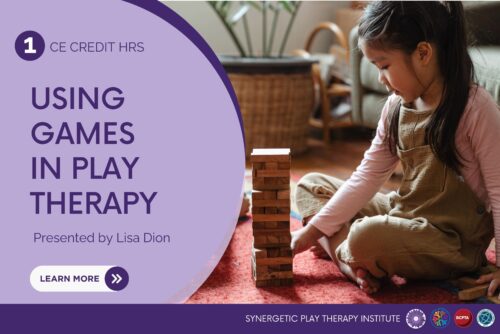
Using Games in Play Therapy
Games are a familiar part of many children's worlds—and they often find their way into the playroom. Whether a child chooses a board game, a card game, or another structured activity, the game itself is only part of the story. The real therapeutic value lies in how the child plays. Do they change the rules? Avoid competition? Need to win? Give up quickly? Invite connection? Every move offers insight into their emotional world.
In this 1-hour home study course, you'll discover how to look beyond the mechanics of a game to better understand what a child may be communicating through play. You'll learn how games can reveal a child's emotional age, regulation patterns, relational dynamics, and ways of navigating challenge, success, frustration, and connection. Rather than focusing on the outcome of the game, you'll explore why observing how a child engages with it provides some of the richest clinical information.
Through the lens of Synergetic Play Therapy, games become more than just activities to fill a session—they become opportunities to deepen attunement, strengthen the therapeutic relationship, and better understand the child's nervous system and internal experience. When we shift our attention from the game itself to the process unfolding within it, even the simplest game can become a powerful window into healing.
Using Games in Play Therapy quantity
Helping Children through Divorce and Separation
Divorce and separation can change a child's world—but they don't affect every child in the same way. Some children experience overwhelming grief, confusion, or loyalty conflicts, while others feel relief as family dynamics shift. As play therapists, our ability to stay curious, regulate our own reactions, and see beyond our assumptions can make all the difference.
In this 1-hour home study course, you'll gain practical insights for confidently supporting children and families navigating divorce and separation. Learn how your own beliefs about divorce may influence the therapeutic process, discover strategies for creating clear boundaries and communication with parents, and deepen your understanding of complex family dynamics, including parental alienation. Whether divorce is amicable or highly conflicted, this course will help you feel more prepared so you can remain grounded in the midst of family complexity and better support the child's unique experience.
Helping Children through Divorce and Separation quantity
A Multimodal Approach to EMDR Therapy with Children
This one-hour home study course explores a multimodal approach to EMDR therapy with children through the Adaptive Information Processing (AIP) model. Recognizing that children often communicate through play, movement, symbolism, and creativity rather than words alone, this approach integrates play therapy, sandtray, expressive arts, storytelling, and other creative interventions to support the processing and integration of distressing experiences.
Participants will explore how these approaches can be incorporated throughout the eight phases of EMDR therapy to support engagement, emotional regulation, and adaptive processing. Special attention is given to developmental needs, affect tolerance, and the therapeutic use of symbolic expression when working with children who have experienced trauma, attachment disruptions, and other adverse life experiences.
A Multimodal Approach to EMDR Therapy with Children quantity



 Synergetic Play Therapy Institute has been approved by NBCC as an Approved Continuing Education Provider, ACEP No. 7450. Programs that do not qualify for NBCC credit are clearly identified. Synergetic Play Therapy Institute is solely responsible for all aspects of the programs.