-
 Eating challenges in children can show up in many ways. From the refusal to eat to eating too much, underneath often lies the need for perfectionism and control. Helping kids take these challenges off their plates involves offering choices and uncovering co-existing issues, as well as providing parental support. This course takes a look at this important struggle.
 -
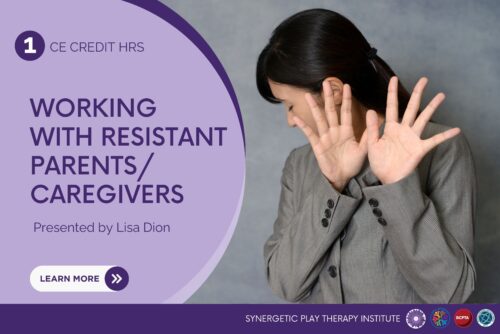 From the dad with doubts to the mom with mixed emotions, not all parents are sold on the idea of play therapy. The resistant parent is a parent who may have questions, shame, or confusion about the process. This course explores how to encourage parental understanding of the power of play and why it’s a key step in helping children heal.
 -
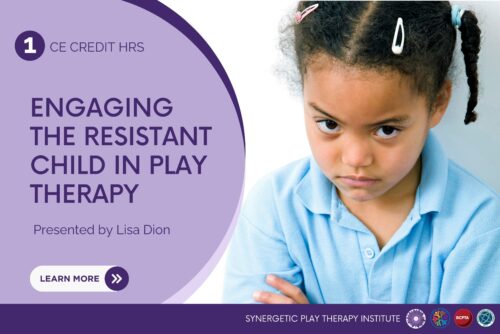 Every therapist has been there – in a session with a child who doesn’t want to come in the room, a child who doesn’t want to do the task, a child who only wants to avoid the issue. This course explores what to do when a child client’s language and behavior say “no.” Join us as we explore resistance- what it is and what it is not. This course will further explore emotional avoidance and flooding as components of resistant behaviors.
 -
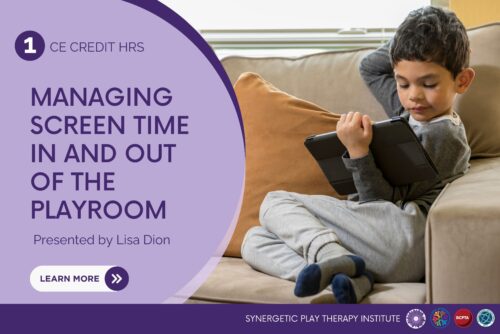 We live in a technological age: there is no pacifying Pac-Man, no axing Apple. But screen time doesn’t always mean zoning out. In moderation, Mickey Mouse and Mario can be our allies, helping children better connect to the world around them. This webinar explores the therapeutic value of screen time and how to use it as part of a play therapy process. Learn how to recognize when a child is using it to avoid and when a child’s use of technology is the perfect entry into the therapeutic alliance.
 -
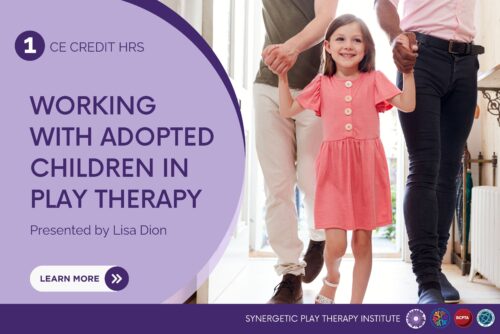 The Synergetic Play Therapy Institute® in collaboration with PIP Solutions presents “Working with Adopted Children in Play Therapy”. Many adopted children have unique challenges which present in different ways in the playroom. Play Therapists can often feel unsure but are aware of the importance of responding through a different lens. In this course, there will be an emphasis on the importance of working with the child’s neuro-biological processes such as regulation and dys-regulation, as well as the importance of educating and working with the child’s adoptive parents.
 -
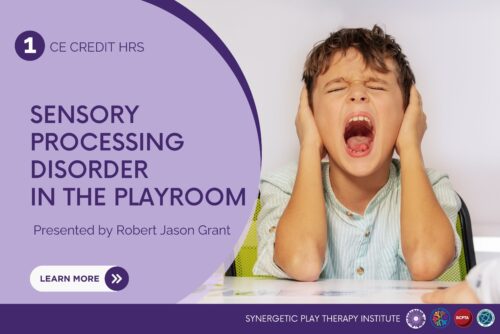 Lisa Dion and Dr. Robert Jason Grant, creator of AutPlay Therapy, discuss what Sensory Processing Disorder is, how to begin to understand it in the context of play therapy, and offer helpful suggestions for therapists to get started.
 -
 Divorce. The “D” word. The end of the marital road. A happily ever after run amok. It’s something that often gets a bad rap, especially when we think of the children stuck in the middle. But divorce, while it can be devastating to some kids, can also be a relief for others. Children’s perceptions are not all the same. This course explores how to support children in play therapy when they are experiencing divorce and separation.
 -
 In response to COVID-19, the Synergetic Play Therapy Institute began offering free webinars to address the challenges, stress and impact that therapists, teachers, parents, and those on the frontlines were facing. Since then, we've continued to offer free webinars to support you on your professional and personal life's journey. Please enjoy free access to these very special webinars. You may view and share it with as many people as you feel it would help.
 -
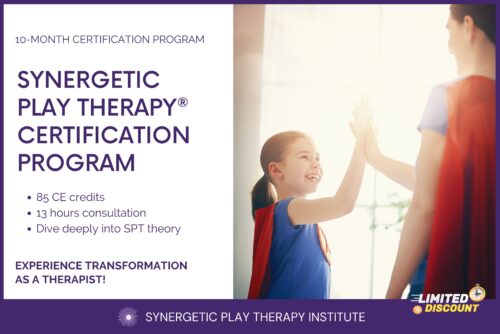
2024-2025 Synergetic Play Therapy® Certification Program
Please use this product to finalize your registration for the 2024-2025 Synergetic Play Therapy® Certification Program. If paying before or by the Early Bird deadline, you may use the coupon code you were provided via email at checkout to apply your discount. The final payment deadline for this program is June 28, 2024. To select your payment option, please use the dropdown menu below to choose your first, 3.5 Day Learning Retreat Online Location. (By selecting your virtual retreat location you are committing to the same location for both program learning retreats.) Your selection will finalize your registration of this program and your pricing option. *Please note: All pricing options will be displayed in USD at checkout. See details below. -
2024-2025 Synergetic Play Therapy® Certification Program
Please use this product to finalize your registration for the 2024-2025 Synergetic Play Therapy® Certification Program. If paying before or by the Early Bird deadline, you may use the coupon code you were provided via email at checkout to apply your discount. The final payment deadline for this program is June 28, 2024. To select your payment plan option, please use the dropdown menu below to choose your first, 3.5 Day Learning Retreat Online Location. (By selecting your virtual retreat location you are committing to the same location for both program learning retreats.) Your selection will finalize your registration of this program and your pricing option. *Please note: All pricing options will be displayed in USD at checkout. See details below. -
CLARIFYING! ENERGIZING! EYE-OPENING! INSPIRING! AMAZING!!!!
These are just a few words students have used to describe this course!
CLICK HERE FOR MORE COURSE DETAILS!!
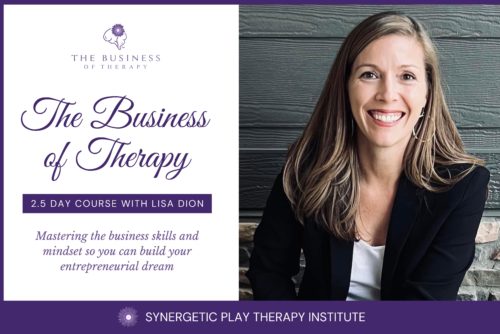
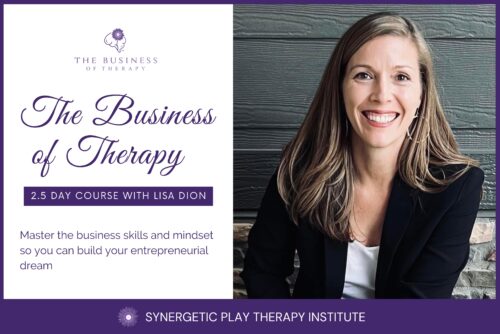
Back by popular demand - revised, energized, and with an in-person and virtual option, join us November 9th-11th, 2023, for the next The Business of Therapy course! Custom designed for therapists, coaches, helpers and healers like yourself, who are deeply committed to making an impact and want to be of greater service - whether it's one-on-one in private practice, launching a product or program, or running a company - Elevate and take your entrepreneurial dream to new heights! This course teaches you the steps involved in building a dream, as well as helps you understand the why behind them so you can think like a business entrepreneur. Plus, for 2.5 days, Lisa Dion, creator of Synergetic Play Therapy®, President of the Synergetic Play Therapy Institute and co-founder of the Synergetic Education Institute, will give you the key ingredients she's learned and discovered along her own entrepreneurial journey. "This weekend was one of the best investments in myself I have ever made." - Bianca Kisselburg This course is for you, if you:- Have a business idea and don't know where to start
- Have a successful business and want to take it to the next level
- Have launched a dream and can't seem to get traction
- Feel overwhelmed by the many to-dos and responsibilities of your business
- Feel alone, confused and filled with self doubt as you think about building and growing your dream
- Keep finding yourself in-debt and/or not able to grow your finances
- Keep finding that your fears and limiting beliefs are stopping your growth
- Want to become more efficient with the business you have (no matter the size of your business) so that your business is working for you, not you having to keep working your business
CLICK HERE FOR MORE COURSE DETAILS!!
Keep scrolling to learn more about this online course! If you know that you would like to attend the course in-person, click here! -
CLARIFYING! ENERGIZING! EYE-OPENING! INSPIRING! AMAZING!!!!
These are just a few words students have used to describe this course!
CLICK HERE FOR MORE COURSE DETAILS!!
Back by popular demand - revised, energized, and with an in-person and virtual option, join us November 9th-11th, 2023, for the next The Business of Therapy course! Custom designed for therapists, coaches, helpers and healers like yourself, who are deeply committed to making an impact and want to be of greater service - whether it's one-on-one in private practice, launching a product or program, or running a company - Elevate and take your entrepreneurial dream to new heights! This course teaches you the steps involved in building a dream, as well as helps you understand the why behind them so you can think like a business entrepreneur. Plus, for 2.5 days, Lisa Dion, creator of Synergetic Play Therapy®, President of the Synergetic Play Therapy Institute and co-founder of the Synergetic Education Institute, will give you the key ingredients she's learned and discovered along her own entrepreneurial journey. "This weekend was one of the best investments in myself I have ever made." - Bianca Kisselburg This course is for you, if you:- Have a business idea and don't know where to start
- Have a successful business and want to take it to the next level
- Have launched a dream and can't seem to get traction
- Feel overwhelmed by the many to-dos and responsibilities of your business
- Feel alone, confused and filled with self doubt as you think about building and growing your dream
- Keep finding yourself in-debt and/or not able to grow your finances
- Keep finding that your fears and limiting beliefs are stopping your growth
- Want to become more efficient with the business you have (no matter the size of your business) so that your business is working for you, not you having to keep working your business
CLICK HERE FOR MORE COURSE DETAILS!!
Keep scrolling to learn more about this course and the In-Person Experience! If you know that you would like to attend the course online, click here!